How to know if your train is not running
Check train line status
The best way to check for up-to-date information is to visit Train line status.
On this page you'll find information about anything affecting train services and stations in the next 21 days such as delays, cancellations, planned rail closures or changes to station access.
If you’re in the station
In train stations, any delays or cancellations will show on the digital screens around the station, and our staff will make audio announcements.
At a major station, you can ask staff on the platform or at the help desk for directions and advice on when the next trains are expected to be running.
Get personalised alerts for your train line
You can get personalised updates about changes to your train line or station through the AT Mobile app.
To get these alerts:
- Go to the AT Mobile menu and select 'Get service alerts'.
- Search for and select the train lines and stations you want to get alerts about.
- You can choose to get alerts for all times or only peak or off-peak hours.
You will get alerts when your service is cancelled, delayed or detoured along with advice about what you can do next. You can change your preferences at any time.
Download the AT Mobile app to get started


Alternative transport options
If your train is cancelled, you have several different options for how to complete your journey.
Transfer to another rail service
If multiple trains run through your station, you may be able to transfer to another train line that will take you to or close to your destination.
Train network maps can be found at all stations showing you where you can transfer to another line. You can also view our map online.
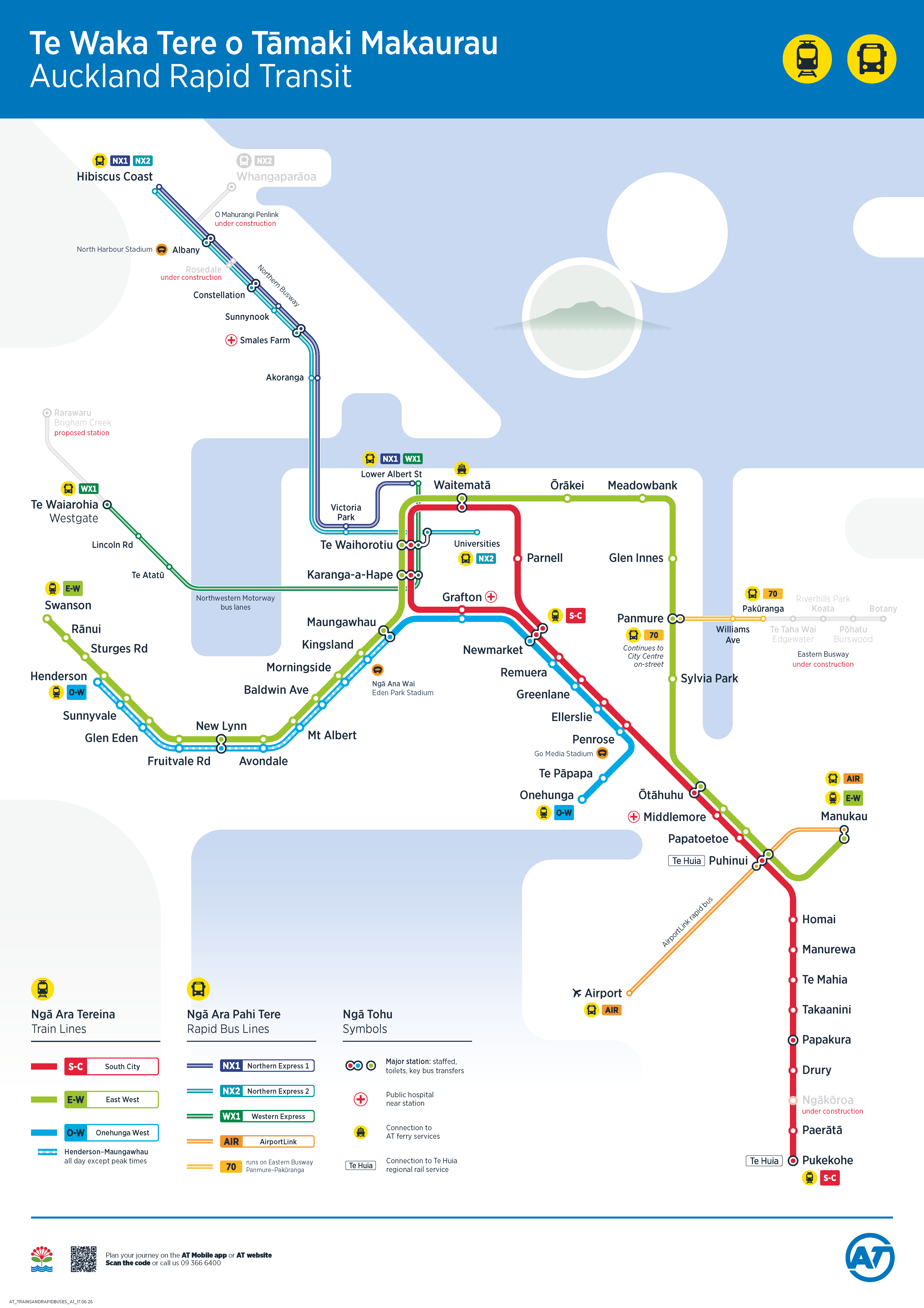
Trains will skip any closed stations and stop at the nearest available stop. Trains may also detour through lines or stations that aren't their usual route. For example, if there is an issue at Te Waihorotiu station, the South City Line might detour at Newmarket and travel through Parnell to allow customers to still get to Waitematā.
Rail replacement buses
You can use a replacement bus service where available. Depending on the rail line and your location, rail buses may take you to a nearby station to transfer to another train, so you can get to your destination faster.
Use Journey Planner on the AT Mobile app or AT website to plan your journey on rail replacement buses when these are available.
Learn more about rail replacement bus options.
Regular scheduled buses
The train network connects to high frequency bus routes, such as the NX1, WX1, 70 and Airport Link. If your train isn’t running, there might be a bus coming past the station that will get you where you need to go.
The best way to know which bus to take is by using Journey Planner. This tool maps your journey using a combination of different services so you can select the option that works best for you.
In station help
You will find maps at every train station showing your alternative transport options including where to take rail replacement buses and regular scheduled buses.
Some stations will have customer service hubs where our friendly staff can help you answer questions.
Rail replacement buses
Rail buses follow the train line, stopping at or near stations on that line. In some cases, a rail bus may take you to a nearby station to transfer to another train so you can reach your destination faster.
Rail buses follow a different timetable to trains, due to their road-based route. Use Journey Planner to plan your trip.

RBS buses service the South City line (S-C) between Te Waihorotiu and Pukekohe.
The RBS will connect you to major bus interchanges on the outskirts of the city centre such as Newmarket and Grafton. From here you can get a high-frequency service such as the Inner Link or Outer Link into the city.
Buses will not service Parnell, Waitematā and Karanga-a-hape to reduce bus volumes in the City Centre.

RBE buses service the eastern side of the East West line (E-W) between Waitematā and Manukau.
When Meadowbank Station is impacted, the RBM will run between Meadowbank Station and Remuera Road.

RBW buses service the western side of the East West line (E-W) between Waitematā and Swanson.

RBO services the Onehunga West line (O-W) between Onehunga and Henderson.
There may be times when a rail closure affects both the E-W and O-W lines west of Maungawhau Station. In this case, a single replacement service, the RBW, will service both lines as they share the same stations.
How to find your replacement bus
View maps online for where replacement buses stop at each train station or check the posters in the station.
Usually, replacement buses are regular blue AT Metro buses. They will display 'Rail Bus’ and their destination on the front of the bus. If the replacement doesn't have blue AT branding it will still clearly display 'Rail Bus' on the front of the bus.
How to pay for rail replacement buses
You pay for travel on a rail bus in the same way as regular train and bus services.
Onboard the bus you can use a contactless payment method or your AT HOP card. You can also use a paper ticket purchased from the ticket machine at the train station.
Tag on and off on the replacement bus as you would on a normal bus trip. If transferring to a train for part of the journey, please tag on and tag off at the first and last train station.
Accessibility on rail buses
We try to make rail replacement buses accessible to all passengers.
However, customers with large wheelchairs or mobility scooters may need to take a (free) mobility taxi. Phone us on 09 366 6400 to book one.
Why your train may be cancelled
Trains may be cancelled for a variety of reasons including emergencies, planned maintenance or unexpected problems like track, signal and power line issues.
Planned maintenance
Carrying out regular maintenance of the rail network is important to keep everyone safe and improve reliability on the network. This work ensures that the tracks, overhead powerlines and structures like bridges or tunnels are regularly serviced.
When work is being done on the network, overheard powerlines need to be shut off so that workers can operate safely. Powerlines are connected to whole segments of the tracks, so even if a very small area needs work, we sometimes need to close off larger areas, affecting multiple stations.
We'll let you know in advance of any planned closures.
Unplanned cancellations
Trains may be cancelled without advanced notice if there is an unexpected problem or a safety issue. When this happens, we will let you know through announcements at stations or inside trains, and digital information boards around platforms.
If you’re signed up to get alerts in the AT Mobile app, you will get a notification letting you know what has happened and what you can do next. We'll also update Train line status and Journey Planner.
Rail replacement buses may be organised for a major disruption. Staff at stations will let you know when these are available, and information will be shared in the AT Mobile app.
Often the best alternative for unexpected issues is a nearby scheduled bus. You can use the Journey Planner in the AT Mobile app to find the best option for your journey.
Different types of rail line closures
Full line closure means the entire train line is closed.
Partial closure means only a part of the line is closed. Trains will continue to run on the rest of the line and alternative transport options will be available for the section of the closed line.
Trains running less often may happen when there are delays or cancellations. For example, a service that usually runs every 10 minutes, will run every 20 minutes instead.
Night works means that maintenance work will happen overnight so trains can continue to run during the day. The last few services of the night will usually be cancelled, to allow workers to get as much done as possible overnight. Alternative transport options will be available for any cancelled trains.