Morningside Drive rail level crossing
We’re making plans to replace western rail level crossings with safer connections.

On this page
Project details
Start date
March 2026End date
TBCLocation
MorningsideTransport involved
Walking, driving, cycling and busOverview
To find safer, smoother ways to keep you moving as the city grows and more trains are needed, we’re planning for the future of the Morningside Drive rail crossing.
It is part of the Western Rail Crossings Programme, to allow more frequent trains while keeping traffic moving, improving safety and supporting urban development.
Morningside Drive is a busy crossing at the heart of a growing mixed-use area - surrounded by commercial, recreational and established residential areas.
It provides access to Morningside Station, local businesses, new apartments and the wider road network. Large multi-storey apartments and other developments have been built or are planned immediately adjacent to the crossing, putting pressure on space.
It also plays a role in event traffic and public transport when Eden Park is busy and is often used as a diversion route when New North Road near Kingsland is closed for large events.
It provides access to the eastern end of the central platform at Morningside Station from the at-grade crossing and is used by the 22N (New Lynn) and 22R (Rosebank) bus routes.
We are also investigating quick, low-cost improvements at Morningside Drive to improve traffic flow. We will share more details as the work progresses.
Latest updates
Feedback closed on 28 September 2026
We engaged with the community on potential options being considered at the Morningside Drive rail crossing. Across the project area, we:
- dropped posters and brochures
- posted letters to nearby property owners
- door-knocked local businesses
- held 5 community engagement events and 4 focus group sessions.
Thank you to everyone who shared their thoughts in person or online.
The engagement report will be available soon.
The options we are considering for replacing the rail crossing
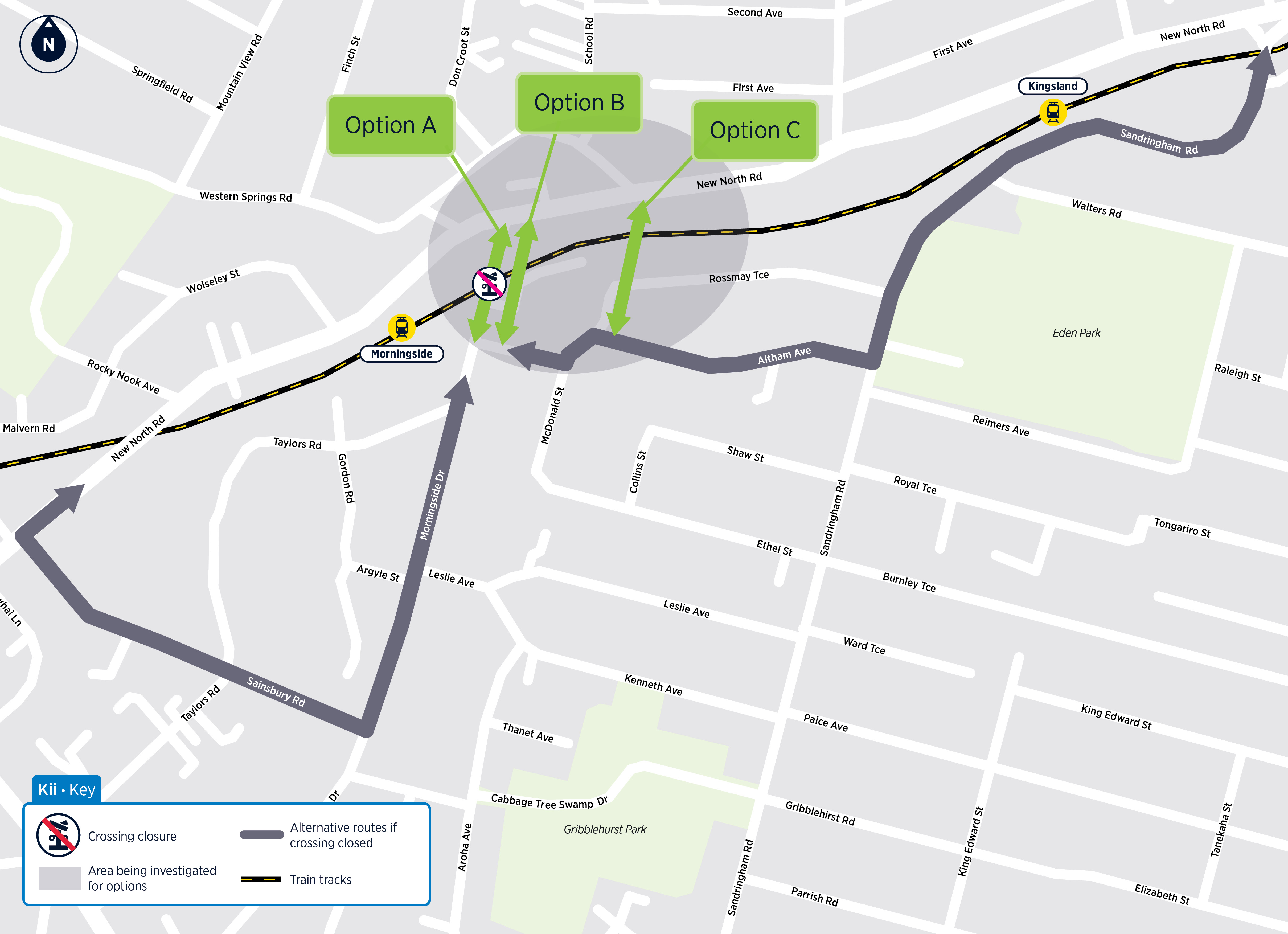
Option A: Pedestrian bridge at Morningside Drive to access the station (no vehicle crossing)
- Traffic will need to use alternative routes to cross the rail line with significant disruption to traffic, bus services and event detour routes.
- Estimated construction timeframe of 12 to 18 months.
- Likely to be the cheapest option.
Option B: Road bridge at Morningside Drive for people and vehicles with pedestrian access to the station
- New North Road will need to be raised due to gradients and level differences.
- Current crossing to be closed and disrupted during construction.
- Estimated construction timeframe of 4 to 5 years.
- Road bridge options likely to be similar levels of cost.
Option C: Road bridge to the east for people and vehicles, plus a pedestrian bridge at Morningside Drive to enable access to the station
- Connection work will be needed on either side (New North Road and McDonald Street).
- Current crossing could remain open during construction.
- Estimated construction timeframe of 3 to 4 years.
- Road bridge options likely to be similar levels of cost.
Options we investigated and decided not to progress
Full road and active mode closure
Why we will not progress this option: Loss of connectivity and ability for the station to operate effectively.
Road underpass
Why we will not progress this option: Topographic constraints and additional complexity from flooding and services.
Closure with pedestrian underpass
Why we will not progress this option: Topographic constraints and additional complexity from flooding and services.
Rail underpass
Why we will not progress this option: Much higher cost and disruption. Positive urban development potential adjacent, but urban benefits not sufficient to justify cost of this option. Poor value for money.
Rail overbridge
Why we will not progress this option: Much higher cost and disruption. Some urban development potential, but urban benefits not sufficient to justify cost of this option. Poor value for money.
New connections to the west
Why we will not progress this option: Reduced benefits and impact on Mount Albert Primary School.
Timeline
Investment case
During the next two years, we’ll identify the preferred approach to replace western rail level crossings with safer connections, and how to prioritise when they’re built. This is key to developing an investment case to seek funding for future phases.
This stage includes:
- Technical assessments: such as traffic and pedestrian counts, safety audits, ground investigations, environmental and flood analysis, and urban design studies. We’ll consider past trends, current conditions and future needs.
- Community input: we’ll engage mana whenua, local boards, elected members, schools, businesses and communities to understand how crossings are used today and what’s needed for the future.
We’ll share what we find to support discussions about potential options, including key constraints and trade-offs. Community feedback will help shape the preferred approach for each crossing.
Statutory approvals
After an approved investment case, the next step will be to seek funding for statutory approvals. These are needed to consent or protect the land required for a future crossing.
Protecting land now means that projects can be constructed in stages as funding is available.
It also provides property owners, businesses and the community with certainty on where transport routes will be in the future. This can help people make informed decisions about their own land and the development of that land.
During this phase, we will:
- Engage one-to-one with directly affected landowners.
- Continue working with elected members, mana whenua and stakeholders.
Detailed design and construction
Designs will continue to be refined through targeted engagement in this phase.
Construction will be staged according to network needs. While we expect to start replacing some rail crossings in the Inner West from early to mid-2030s, timeframes are dependent on funding.
During this phase, we will:
- Engage one-to-one with directly affected landowners.
- Continue working with elected members, mana whenua, and key stakeholders.
- Communicate clearly with communities about construction timing, disruption, and how we'll manage the impacts of construction.
Feedback closed
Project background
The next 20 to 30 years will see more people living, working and studying close to the rail corridor, especially train stations. That means more people taking trains, walking and cycling to stations and more activity around the rail corridor.
Replacing rail crossings with safer connections is key to unlocking the full City Rail Link benefits of allowing even more trains to run in the future while making it safer and easier to get around your local area. It also supports urban development.
If we don’t replace level crossings people may take more risks as barrier arms are down more often and there will be increased congestion, impacting the economy.
From March 2026, we engaged with our partners, stakeholders, businesses and local communities. We shared information about the Rail Level Crossings Programme and heard initial feedback. Groups we talked to included:
- local government representatives, like local boards and councillors
- mana whenua representatives
- transport advocacy organisations
- community stakeholders, like schools and business associations
- residents and commuters, who regularly use rail crossings.
What we've heard from the community
We received 502 survey responses for Morningside Drive. We heard that:
- there was strong support for a bridge or underpass to separate the road and rail
- there is a strong connection to the train station, with approximately 75% of users accessing it via this crossing compared to other entry points, highlighting its critical role in station access
- the area is complex, with multiple movements, interactions, and surrounding land uses to consider
- planning needs to account for future growth and demand, not just current issues
- there is some openness to relocating the crossing, provided it delivers better overall outcomes.
The crossing is in a dense urban environment, close to the Morningside Station.
Large multi-storey apartments and other developments have been built or planned next to the crossing which will make construction challenging, potentially requiring changes to surrounding streets or properties.
Through the next phase of the project, we are considering how to minimise disruption to rail network operations, local businesses, homes and community facilities as much as possible.