Transport Design Manual Transport Design Manual
New releases
Practice Note 09 Sight distances at Zebra Crossings edition 1 (December 2025) (PDF, 1.4MB) – See Section 4: Practice Notes, with immediate effect from December 2025.
Practice Note 11 CCTV Traffic Observation Cameras edition 1 (October 2025) (PDF, 288KB) – See Section 4: Practice Notes, with immediate effect from December 2025, supplements Auckland Transport Operation Centre - Traffic Signals Design Guidelines version 5.0.
ASD-SiSD Distance Calculation, edition 1 (January 2026) (XLSX, 345KB) – Appendix document for Practice Note 09 (Sight distances at Zebra Crossings edition 1): Calculation tool for pedestrian crossing sight distance.
Download the Footpaths and pedestrian facilities Engineering Details March 2026 (PDF, 2MB) – See subsection Standard Engineering Details, under section 2: Detailed Technical Requirements.
The Transport Design Manual is a set of guides, codes and specifications created for the Auckland region based on international best practice and robust common engineering theory.
- Section 1: Design guidance
- Section 2: Detailed technical requirements for Engineering Design Code and Standard Engineering Details
- Section 3: Specifications for Transport Infrastructure
- Section 4: Practice Notes
- Supporting appendix documents
- Version history
Background
Roads and streets represent a large portion of public space in Auckland and cater for a wide variety of users undertaking many different activities.
The Auckland region is comprised of 70% rural area and 30% urban area, with the majority of people living and working in the urban area. The scale and pace of growth in Auckland combined with increasing intensification and the development of Auckland's urban areas and Greenfields are placing increased pressure on an already constrained road network and limited road space to deliver quality place and multi-modal transport objectives.
To address this pressure, AT and Auckland Council have been looking at better ways to plan and manage our roads and streets to better reflect the full range of modes, activities and functions that occur on them.
Purpose
The Transport Design Manual (TDM) provides the design guidance and engineering requirements for the development and delivery of well-designed transport projects and their operation. The manual draws upon design approaches and practices, which have been successful in many cities and rural areas worldwide.
The TDM has 3 sections, design principles, engineering standards and specifications. Together, these sections allow end user outcomes, engineering design and construction requirements to be clearly identified and designed. The manual has been created to be a cascaded principle based approach that ensures consistency from strategic planning through to detailed design and construction of the outcomes.
The entire manual sets out:
- the design principles and approaches to designing user outcomes.
- how to apply safe design and safe speed requirements to achieve Vision Zero outcomes.
- design guidance and key transport catchment for designing liveable, connected neighbourhoods and town centres, particularly in Greenfields.
- how to build a street from basic elements and how intersections should be designed to support this.
- the detailed engineering requirements to design and construct the facilities necessary for the users identified by the Design Guides.
- the construction specifications required to achieve consistent construction outcomes, including the opportunities to utilise recycled, synthetic and manmade products.
The Roads and Streets Framework and Transport Design Manual are complementary documents. Both documents when applied together will provide guidance to internal staff (such as Council family project teams), external parties (such as Government agencies, consultants and developers) about AT's requirements for the planning, design, construction and management of the road and street network, and the vesting of assets that will be managed by AT.
The TDM is a living document that is continually updated to ensure they are fit for purpose and reflect best practice.
Working together in an integrated approach
The Transport Design Manual brings together the key players in the design, development and improvement of Auckland's road and street network so that the strategic and local place and movement functions are balanced and integrated to meet the multiple outcomes sought from them. The early involvement of the Council family of organisations, key partners such as Mana Whenua, Waka Kotahi NZTA and other stakeholders such as developers and utility companies is critical. The process is deliberately holistic and multi-disciplinary, recognising that no one profession or organisation has all the answers in how to achieve integrated and place-sensitive solutions for roads and streets.
The TDM is for everyone who plays a part in managing, designing, improving or determining the quality of roads and streets in Auckland, including engineers, planners, urban designers, project managers, developers, politicians and users.
Strategic fit
Strategic documents such as the Auckland Transport Alignment Project and the Auckland Plan, together with Future Connect feed into the Roads and Streets Framework providing strategic direction. In turn, the Road and Streets Framework provides the vision for streets, guiding the Transport Design Manual as shown in the figure below.
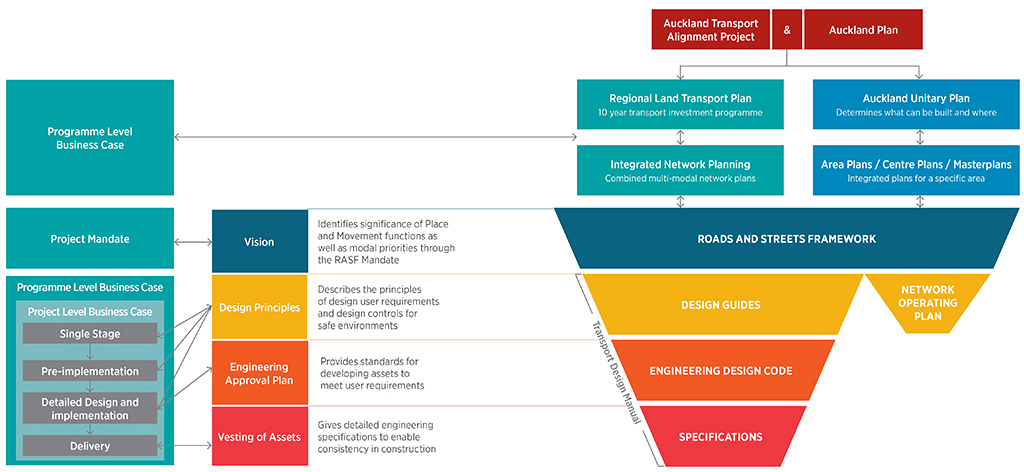
Download image depicting strategic direction (JPG 269KB)
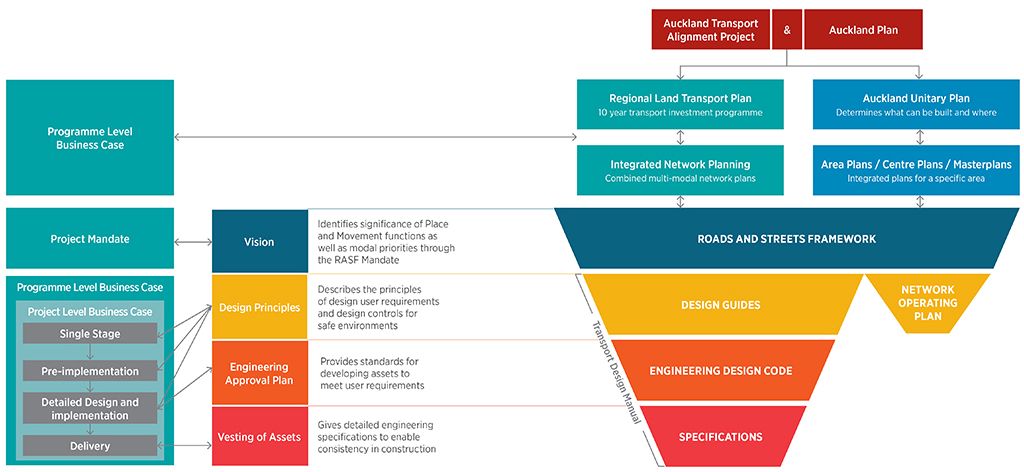
The Transport Design Manual provides the design and technical specification to deliver projects and other improvements that ensure projects are aligned to strategic direction.
Section 1: Design guidance
- Download the Urban Street and Road Design Guide version 1.2: Business technology update (PDF, 15.4MB).
- Download the Waitakere Ranges Design Guide version 1 (PDF, 11.6MB).
- Download the Public transport interchange design guidelines (PDF, 2.4KB).
- Download the Signage and Wayfinding Design Guide version 2.1 (PDF, 9.6MB).
- Download the Bioretention Design Guide, Version 2 (PDF 2.6MB, 17 pages). with immediate effect from February 2025.
- Download the Bioretention Planting Guide Final Version (2.1MB, 36 pages)
- Download the Swale Design Guide (PDF 1.2MB, 13 pages).
- Download the Local Paths Design Guide (PDF, 18.7MB).
Section 2: Detailed technical requirements
Engineering Design Code
Includes minimum standards, considerations and drawings required to undertake accurate and detailed designs based on a component approach for facilities.
- Download the Engineering Design Code - Urban and Rural Roadway Design version 2 (PDF, 1.6MB).
- Download Auckland Transport Operation Centre - Traffic Signals Design Guidelines version 5.0 July 2022 (PDF, 5.7MB).
- Download the Engineering Design Code - Footpaths and the Public Realm version 2 (PDF, 2.6MB).
- Download the Engineering Design Code - Cycling Infrastructure version 1 (PDF, 5.6MB).
- Download the Engineering Design Code - Public Transport-Bus Infrastructure version 1 (PDF, 6.2MB).
- Download the Engineering Design Code - Public Transport - Rail Infrastructure version 2 (PDF, 3.8MB).
- Download the Engineering Design Code - Public Transport - Ferry Infrastructure version 2 (PDF, 1.2MB).
- Download the Signage and Wayfinding Design Code version 2.1 (PDF, 102MB).
- Download the Engineering Design Code - Parking version 2 (PDF, 982KB).
- Download the Engineering Design Code - Traffic Calming version 1 (PDF 2.6MB).
- Download the Engineering Design Code - Road Drainage and Surface Water Control version 1 (PDF 6.5MB).
- Download the Engineering Design Code - Street Lighting version 1 (PDF, 3.9MB).
- Download Engineering Design Code – Pavements and Surfacing version 1 (PDF, 6.2MB). This Pavements and Surfacing EDC is issued as Draft with immediate effect from July 2025 to be used as preferred alternative to AT Code of Practice (ATCOP) version 2013. Feedback can be emailed to TransportDesignManual@at.govt.nz before 31 January 2026.
- Download the Infrastructure asset acceptance process and data requirements (PDF, 3.9MB).
Standard Engineering Details
Standard details for common elements such as kerbs, footpaths and drainage devices.
- Download the Footpaths and pedestrian facilities Engineering Details (PDF, 2MB) - March 2026.
- Download the Geometric Design Standard Engineering Details version 2 (PDF, 422KB) - July 2025.
- Download the Vehicle Tracking Envelopes version 2 (PDF, 10.4MB) - July 2025.
- Download Cycling Infrastructure Standard Engineering Details (PDF, 2.7MB) - July 2024.
- Download the Kerbs and Channels Standard Engineering Details version 2 (PDF, 620KB) - July 2025.
- Download the Vehicle Crossings Standard Engineering Details version 2 (PDF, 1.6MB) - July 2025.
- Download the Parking Standard Engineering Details version 2 (PDF, 439KB) - July 2025.
- Download the Traffic Calming Standard Engineering Details (PDF, 2.9MB) - July 2025
- Download the Fences Standard Engineering Details (PDF, 769KB).
- Download the Road Drainage Standard Engineering Details (PDF, 1.4MB).
- Download the Islands Standard Engineering Details (PDF, 449KB).
- Download the Signs and Markings Standard Engineering Details (PDF, 767KB).
- Download the Structures Standard Engineering Details (PDF, 570KB).
- Download the Traffic Signals Standard Engineering Details (PDF, 79KB).
Section 3: Specifications for Transport Infrastructure
Download Series 0800 - Specification for the supply of aggregates (PDF, 262KB).
Section 4: Practice Notes
Practice Notes have effect immediately on publication. They may override published TDM standards for urgent safety reasons. Necessary changes to affected TDM documents will be incorporated in future updates.
- Download Practice Note 01 , Road Stormwater Catchpit - Spring Latch (Safety) Grates Practice Notes (PDF, 305KB).
- Download Practice Note 02, edition 2 (June 2024) - Use of raised devices on the AT Network (PDF, 582KB). Replaces Raised safety platforms (speed tables) - Practice Note 02, edition 1, with immediate effect from 1 July 2024.
- Download AT Raingarden Practice Note 03, edition 1 (March 2025) (PDF, 914KB).
- Download Practice Note 04 cycling infrastructure — interim facilities edition 1 (July 2024) (PDF, 7.2MB). Immediate effect from 17 July 2024.
- Download Practice Note 05, Low Carbon Concrete edition 1(July 2025) (PDF, 514 KB).
- Download Practice Note 06 vertical and horizontal clearance over and beside bus routes, edition 1 (July 2025) (PDF, 930KB).
- Download Practice Note 07 Vehicle Crossings Design Standards edition 1 (July 2025) (PDF 2.2MB). Immediate effect from August 2025
Go to Appendix documents for Practice Note 07: Ed 1 - Vehicle Crossings Design Standards - Download Practice Note 09 Sight distances at Zebra Crossings edition 1 (December 2025) (PDF, 1.4MB)
- Download Practice Note 11 CCTV Traffic Observation Cameras edition 1 (October 2025) (PDF, 288KB).
Legacy AT Code of Practice
The AT Code of Practice cannot be utilised for new projects, except for ATCoP Section 15: Earthworks (PDF, 300 KB) and ATCoP Section 18: Structures (incl. bridges, retaining walls etc.) (PDF, 368 KB) until these are covered in the TDM. In those cases, ATCoP applies but designers should seek advice from AT Design and Engineering specialists.
Road Pavements & Surfacings (PDF, 1.91 MB) may be used while Engineering Design Code – Pavements and Surfacing version 1 (PDF, 6.2MB) remains in Final Draft but designers should seek advice from AT Design and Engineering specialists.
Supporting appendix documents
Appendix documents for Street Lighting Engineering Design Code
- A HID Roadway Lighting - Specification v3-2018-08-26 (PDF, 163KB)
- B1 LED Roadway lighting - Luminaire specification v6_2020-07004 (PDF, 360KB)
- B3 LED Roadway Lighting - Luminaire assessment - summary of required review materials v4-2021-01-15 (PDF, 413KB)
- B5 LED Roadway Lighting - Luminaire labelling system v4-2020-07-09 (PDF, 442KB)
- B6 LED Roadway Lighting - Luminaire label reference chart AT LLRC v8-2020-08-06 (PDF, 474KB)
- C1 LED Amenity Lighting - Luminaire specification v6-2020-07-04 (PDF, 274KB)
- D1 Roadway Lighting - Column specification v8-2019-06-05 (PDF, 493KB)
- F LED Roadway Lighting - Approved luminaires list - AT LALL v30-2021-01-15 (PDF, 454KB)
- G LED Amenity Lighting - Approved luminaires list - AT ALAL v16-2020-12-21 (PDF, 282KB)
- H Roadway Lighting - Approved column list - AT LCAL v15-2020-09-22 (PDF, 426KB)
- K1 Fig 1 Drawing E04 Street Lighting Electrical Connections v4-2020-01-14 (PDF, 149KB)
- K2 Fig 2 Drawing E03 Street Lighting Earthing Details v5-2020-12-04 (PDF, 134KB)
- K3 Fig 3 Drawing E05 Traffic Signal Street Light Combination Electrical Schematic v5-2020-04-07 (PDF, 131KB)
- K4 Fig 4 Drawing E02 Typical Shear Base Detail v4-2020-01-14 (PDF, 169KB)
- L Electrical Cable Specification v2-2020-12-04 (PDF, 487KB)
Appendix documents for Practice Note 07: Ed 1 - Vehicle Crossings Design Standards
- Download Appendix 1: Attachment A – Process to apply for Vehicle Crossing approval onto a vested Public Road (PDF, 136KB).
- Download Appendix 1: Attachment B – Example drawings (PDF, 323KB).
- Download Appendix 2: Checklists for applicant preparation (PDF, 137KB).
Appendix document for Practice Note 09 (Sight distances at Zebra Crossings edition 1) - Calculation tool for pedestrian crossing sight distance
Version history
The following versions have been withdrawn and cannot be used for new designs or applications from the dates given. They remain available for reference covering designs carried out when they were in effect.
Auckland Transport Code of Practice (ATCoP)
This cannot be utilised for new projects, except for Sections 15: Earthworks and 18: Structures (incl. bridges, retaining walls etc.) until these are covered in the TDM. In those cases, ATCoP applies but designers should seek advice from AT Design & Engineering specialists.
Design Guidance
- Urban Street & Road Design Guide Version 1.1 June 2022: Updated to better align with new/updated strategic planning tools (Future Connect, Roads and Streets Framework 2.0). Superseded May 2023.
- Download the Urban Street and Road Design Guide Version 1.0 (original) Superseded June 2022
- Download the Signage and Wayfinding Design Guide version 1 (PDF, 19MB) . Superseded November 2024
- Download the Signage and Wayfinding Design Guide version 2 (PDF, 6MB) . Superseded August 2025
- Download the Bioretention Design Guide Version 1 April 2021 (PDF 1MB, 13 pages) Superseded Feb 2025
Engineering Design Code
Download the Signage and Wayfinding Design Code version 2 (PDF, 6.5MB). Superseded August 2025
Other original versions apply except where they are varied by Practice Notes.
Standard Engineering Details
- Download the Footpath Standard Engineering Details (PDF, 1.9MB) - Superseded March 2026.
- Download the Geometric Design Standard Engineering Details (PDF 381KB). Superseded Sept 2024
- Download the Vehicle Tracking Envelopes (PDF 2MB). Superseded Sept 2024
- Download the Footpaths Standard Engineering Details (PDF 1.6MB). Superseded July 2024
- Download the Cycling Standard Engineering Details (PDF 259KB). Superseded July 2024
- Download the Parking Standard Engineering Details (PDF 729KB). Superseded Sept 2024
- Download the Traffic Calming Standard Engineering Details (PDF 658KB). Superseded July 2025
- Download the Fences Standard Engineering Details (PDF 721KB). Superseded Sept 2024
- Download the Islands Standard Engineering Details (PDF 462KB). Superseded Sept 2024
- Download the Signs & Markings Standard Engineering Details (PDF 578KB). Superseded Sept 2024
- Download the Structures Standard Engineering Details (PDF 474KB) . Superseded Sept 2024
- Download the Street Lighting Standard Engineering Details (PDF 153KB). Superseded Sept 2024
- Download the Traffic Signals Standard Engineering Details (PDF 72KB). Superseded Sept 2024
Specifications for Transport Infrastructure
Original versions apply.
Practice Notes
Download Raised safety platforms (speed tables) Practice Note 2 (PDF 500KB) Superseded July 2024
Feedback
Feedback can be sent at any time by emailing TransportDesignManual@at.govt.nz.